
How much does a truck driver earn in Switzerland in 2026?
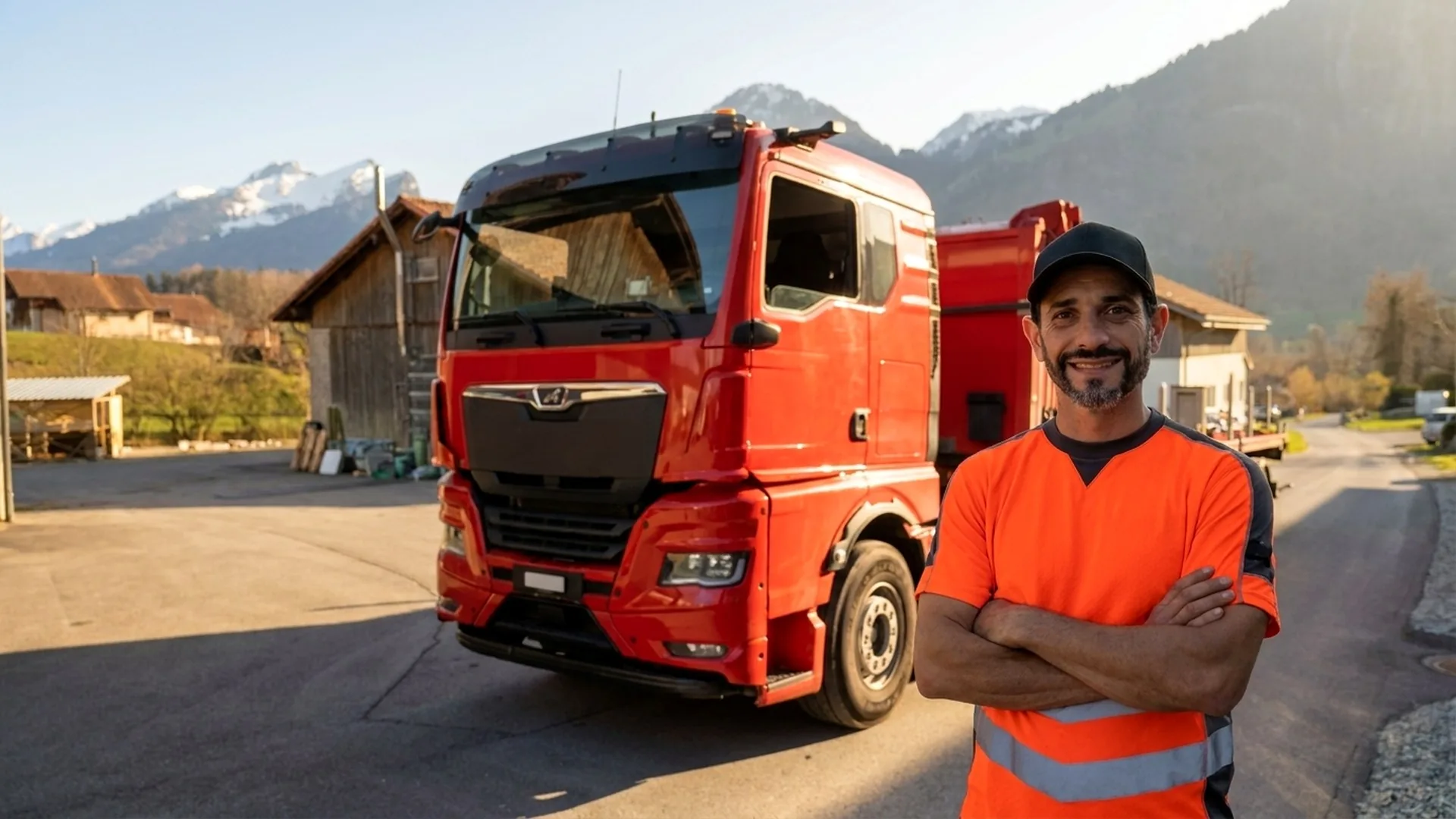
It may be the question that lands in my inbox most often: "how much does a truck driver earn in Switzerland?" I am going to answer as honestly as I can — but I have to start with an important warning, because this subject is a delicate one here.
Why nobody here shows you their own salary
In Switzerland, pay is extremely confidential. There is no fixed minimum for the profession: everyone negotiates their own, and two people in the same role can earn very different amounts. Going around quoting your own number is frowned upon — and it can even work against you at work. That is why I will never show you my payslip. What I can do, and will, is give you the market averages, which are public and real. That is how we talk about money here: in ranges, not in gossip.
The averages by region (monthly gross)
The first thing to understand is that Switzerland has three language regions and they pay differently — the German-speaking part tends to pay more than the French-speaking part, which pays more than the Italian-speaking part:
- German-speaking Switzerland (Deutschschweiz): the strongest. A beginner usually starts at around CHF 4,800 gross and, with experience and qualifications, can reach CHF 6,500 or more.
- French-speaking Switzerland (Romandie): net average in the range of CHF 4,500 to 5,000.
- Italian-speaking Switzerland (Ticino): the lowest, generally between CHF 3,500 and 4,500 net.
Broadly speaking, people working in transport here tend to average CHF 5,000 to 5,500 net, depending on all of the above. And there is the 13th month salary, which exists in Switzerland too — the annual average is normally already counted divided by 13.
Gross is not what lands in your account
This is where people go wrong when they look only at the contract figure. Before it reaches your account, out come the social contributions (AHV/AVS), accident insurance and the pension (second pillar), plus tax depending on your situation. In the end, expect a deduction in the region of 15% to 20% of gross. The big number shrinks — and the household bills are still waiting.
Spesen: the daily allowance not every company pays
Here is a detail few people abroad know about: Spesen, a kind of daily allowance covering meals at work. It runs at around CHF 30 per day worked — but note: not every company pays it. When you are negotiating a job, this makes a real difference at the end of the month and it is worth asking about.
What pushes the salary up
Some factors genuinely increase what you take home: night work, weekend work and carrying dangerous goods (ADR) typically add 10% to 20%. Experience, qualifications and — I say it constantly — language also weigh heavily: German speakers in the German-speaking part get access to the best jobs.
Earning well is not the same as having something left
This is the part that separates the people who prosper from the people who struggle. Pay here is good, but life is expensive too — rent, compulsory health insurance per person, groceries. Earning CHF 5,000 without organising it means CHF 5,000 disappearing. I have already broken down what it costs to live in Switzerland in 2026 so you can see the other half of the equation — because it is the gap between those two numbers that builds your future, or does not. To see it in practice, I put the free NM23 financial tool online, multi-currency, so you can simulate your life here before you even come.
I covered all of this in a video too (in Portuguese) — press play and watch it right here:
In the end, the number that matters is not the one on the contract — it is what is left after life here takes its share. I wanted to show you that unfiltered, because it is the difference between those two numbers that builds your future here, or does not.